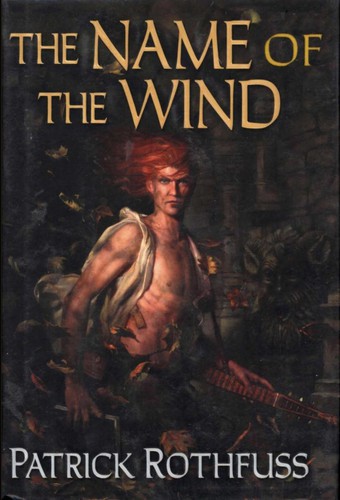
The Name of the Wind by Patrick Rothfuss is a 2007 fantasy book about legend and reality, poverty and ambition, knowledge as power. Legend and reality are almost completely different things. The Kvothe of reputation and the Kvothe of his own narration barely resemble each other, and the novel holds that gap open deliberately.
Summary
The Name of the Wind is the first volume of the Kingkiller Chronicle, told as the oral history of Kvothe — a figure of such mythological status that stories about him have become wildly contradictory and probably false. The framing device places an older, quieter Kvothe running a country inn under an assumed name, who agrees to spend three days telling a scribe his true story. What follows is the inner narrative: Kvothe's childhood as a traveling performer, the massacre that killed his family, years of survival on the streets, and his time at the University studying both conventional magic and the dangerous art of Naming.
The book is about the gap between legend and the person the legend obscures. Kvothe narrates his own story with full awareness of what he has become in popular imagination, and the real story is both more mundane and more painful than the myth. The University sections are the book's engine — a tightly structured academic fantasy where tuition is a real financial problem, social class determines access, and magic (Sympathy) works by rules of physics and mental concentration rather than wand-waving.
Rothfuss's prose is exceptionally controlled for debut epic fantasy. The music — Kvothe is a gifted musician from a family of performers — is central rather than decorative, and the sections involving performance have a sensory immediacy that most fantasy novels don't attempt. The book's structure is deliberate and literary: the framing device adds dramatic irony to every chapter of the inner story, because we know from the opening pages that this brilliance ended somewhere dark.
The ideal reader is someone who enjoys literary voice in genre fiction, who will find the academic magic system genuinely interesting rather than pedantic, and who can accept that volume one of a planned trilogy is doing a great deal of setup. The caveat is that volumes two and three have been delayed for years, and the series may never conclude. Some readers find that fact disqualifying. Others argue the first book is complete enough to stand alone. Both positions are defensible.
Talk to The Name of the Wind like its author wrote you back.
Get the ideas that fit your life — not generic summaries.
- Chat with the book
- Audiobook-style main ideas
- Adapts to your life and goals
- Helps you take action
Key takeaways
- 1.
Legend and reality are almost completely different things. The Kvothe of reputation and the Kvothe of his own narration barely resemble each other, and the novel holds that gap open deliberately.
- 2.
Rothfuss's Sympathy magic system is one of the most intellectually rigorous in modern fantasy — it works by physics, mental discipline, and the conservation of energy, not mysticism.
- 3.
Poverty is treated as a genuine obstacle, not as character-building backdrop. Kvothe's tuition struggles are more stressful than most of his magical conflicts.
- 4.
The music in this novel does real narrative work. The scenes where Kvothe performs tell you things about character and grief that the plot sections don't.
- 5.
The framing device — an older Kvothe telling his own story — adds dramatic irony to every scene. We know this brilliance leads somewhere terrible, and the novel uses that knowledge.
- 6.
Grief for the Edema Ruh and his family shapes everything Kvothe does. The book is quieter about trauma than most fantasy, but no less serious.
- 7.
The University sections show that access to knowledge has always been about money and class. The magic system being rigorous means the gatekeeping is also rigorous.
- 8.
Kvothe is an unreliable narrator performing his own legend even as he claims to be correcting it. The reader has to hold that lightly throughout.
Discussion questions
Use these on your own, with a book club, or as chat starters in Superbook. Book club version, ready to copy or print →
- 1.
Kvothe claims he is telling his true story to correct the legends. Do you trust him as a narrator? Where does the narration seem self-serving?
- 2.
The framing shows an older Kvothe who has clearly lost something — or done something — that broke him. Did you spend the inner story looking for where it went wrong?
- 3.
The Sympathy magic system is rigorously logical. Does a rational magic system make fantasy more or less interesting to you?
- 4.
Kvothe's poverty at the University is treated as more grinding and humiliating than most fantasy books treat hardship. Did that feel realistic or excessive?
- 5.
The book has almost no female characters with significant agency in volume one. Denna is present but keeps her own story off-page. Is that a structural problem or a deliberate mystery?
- 6.
Rothfuss spent years on this debut novel and the prose is notably controlled. Does literary quality in fantasy fiction matter to you, or is worldbuilding the thing you came for?
- 7.
The gap between Kvothe's reputation and his reality is the book's central joke and its central tragedy. Which version of Kvothe do you find more interesting?
- 8.
Kvothe's family are killed by the Chandrian before the book's action really begins. The loss is present throughout but never processed directly. How does Rothfuss handle grief?
- 9.
By the end of volume one, almost none of the mythological stories about Kvothe have been explained. Does that feel like a promise or a delay?
- 10.
How does the Kingkiller Chronicle compare to other epic fantasy series you've read in terms of what it's actually interested in — plot, character, or prose?
- 11.
Given that the series has been unfinished for many years, does that change how you read the first book? Would you recommend it to a friend knowing that?
- 12.
The book's narrator is performing his own story for an audience within the fiction. Does that layer of self-consciousness add depth or distance?
Themes
Frequently asked questions
-
Is The Name of the Wind worth reading if the series isn't finished?
That depends on your relationship to open-ended stories. The first book has a genuine arc — Kvothe's University years feel complete in themselves — and the prose is good enough that many readers consider it worthwhile even if book three never arrives. But if an unresolved trilogy is a dealbreaker, be warned.
-
Is The Name of the Wind hard to read?
No — Rothfuss's prose is clear and often beautiful, not demanding in the way literary fiction sometimes is. The length (nearly 700 pages) and the academic magic system require some patience, but most readers find the pages moving quickly once the University section begins.
-
What makes this different from other epic fantasy?
The literary ambition of the prose, the rigorous (almost science-based) magic system, and the frame narrative that makes every heroic moment read with irony. It's also unusually interested in music, performance, and poverty as real forces rather than atmosphere.
-
Who shouldn't read it?
Readers who need plot momentum above all else. The inner story covers roughly three years and moves carefully. Readers who are already frustrated that book three hasn't come out may find the investment hard to justify. Readers who want female characters with full agency should know volume one has serious gaps there.
-
Is there a movie or TV adaptation?
A film adaptation has been in development for years, most recently at Lionsgate, but has not been produced as of 2026. No streaming series currently exists.