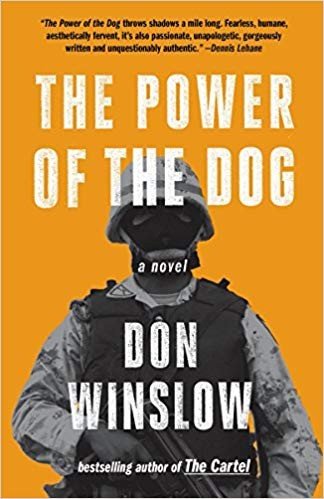
The Power of the Dog by Don Winslow is a 2005 thriller book about the drug war, institutional corruption, moral compromise. The drug war is not a war that can be won — it is a set of institutional arrangements that generate profits for multiple parties, including the parties nominally fighting it.
Summary
The Power of the Dog is Don Winslow's epic of the American drug war, covering roughly three decades from the 1970s to the early 2000s and tracing the rise of the Sinaloa cartel through the lives of a DEA agent, a priest, a hitman, a cartel boss, and several other figures whose fates are bound together by money, faith, violence, and the specific kind of corruption that a war without exit produces. It is one of the most ambitious American crime novels of the past thirty years.
The book operates at several registers simultaneously. It is a procedural, tracking how drug trafficking organizations are built, how they corrupt institutions, and how the DEA, CIA, and Mexican police have fought them, collaborated with them, and been remade by them. It is a character study, following Art Keller — Winslow's DEA protagonist — as he watches the war he has fought for decades produce nothing but different configurations of the same violence. And it is a moral argument, sustained across 600 pages, about what the drug war is actually for and who it serves.
Winslow's prose is controlled and cinematic — he writes in short chapters, often very short, cutting between multiple storylines with the rhythm of a film editor rather than a novelist. The book covers so many characters and such a long span that it risks feeling episodic, but Winslow's structural intelligence holds the whole together. The violence is neither minimized nor exploited; it is presented as consequence, as fact, as the thing that flows from the decisions that came before.
The Power of the Dog is not easy reading. It is long, it is dense, it depicts atrocities with clear eyes, and it reaches a conclusion that is less a resolution than a pause before the next chapter — because Winslow, who knows the history he is fictionalizing, understands there is no resolution. Readers who want closure will not find it. Readers who want to understand how the drug war became what it became will find no better novel.
Talk to The Power of the Dog like its author wrote you back.
Get the ideas that fit your life — not generic summaries.
- Chat with the book
- Audiobook-style main ideas
- Adapts to your life and goals
- Helps you take action
Key takeaways
- 1.
The drug war is not a war that can be won — it is a set of institutional arrangements that generate profits for multiple parties, including the parties nominally fighting it.
- 2.
Art Keller's tragedy is not that he loses. It is that he wins repeatedly and the situation becomes no better, because the structure that creates the problem remains intact.
- 3.
The Sinaloa cartel is depicted as a business, not a criminal aberration. It responds to market pressure, bureaucratic logic, and institutional incentives the way any organization does.
- 4.
American involvement in Mexico through the CIA, the DEA, and political pressure is one of the book's most damning subjects. Winslow shows how that involvement made cartels stronger.
- 5.
The priest Padrino represents the weight of complicity — a man of genuine moral seriousness who compromises incrementally until the compromises define him.
- 6.
Violence in this book is presented as the currency of a particular political economy. It is not sensationalized; it is accounted for.
- 7.
The book covers thirty years because that is how long it takes to understand how the drug war became structural rather than incidental — and structural problems do not have personal solutions.
- 8.
Every character who attempts neutrality is eventually forced to choose a side. The novel argues that neutrality in a system of this kind is itself a political act.
- 9.
Winslow's use of real historical events and figures alongside fictional ones gives the book a documentary weight that most crime fiction cannot achieve.
Discussion questions
Use these on your own, with a book club, or as chat starters in Superbook. Book club version, ready to copy or print →
- 1.
Art Keller dedicates his life to stopping Adán Barrera. By the end of the novel, what has that dedication cost him, and does the book think the cost was worth it?
- 2.
The CIA's complicity with drug trafficking organizations is a documented historical fact as well as a central plot element here. How does fictionalizing real corruption change your relationship to it?
- 3.
The book covers roughly thirty years. Which decade did you find most narratively and morally coherent? Which felt most chaotic?
- 4.
Nora Hayden is one of the novel's most morally complex figures — simultaneously victim, agent, and instrument. How does Winslow frame her choices?
- 5.
Winslow presents the drug war as an institution that reproduces itself. What would it mean to actually end it, and does the novel suggest it is possible?
- 6.
The priest's moral deterioration is gradual and comprehensible at each step. At what point did you feel he had crossed a line he couldn't come back from?
- 7.
Adán Barrera is not a monster — he is a strategist operating in an environment with very specific rules. How does that framing affect your moral response to him?
- 8.
Compared to Blood Meridian — another American novel that uses violence as a way of reading the country's soul — how does The Power of the Dog's approach differ?
- 9.
Winslow refuses a cathartic ending. Is that the honest choice given the subject matter, or does it withhold something readers are owed?
- 10.
The book is long. Were there sections that felt like they cost narrative momentum, or did every strand justify its space?
- 11.
The drug war depicted here is primarily a story about institutional failure. Who in the book is not, in some way, an agent of that failure?
- 12.
Winslow continued the story in The Cartel and The Border. After finishing The Power of the Dog, do you want to continue, or does this book feel complete?
- 13.
The title comes from Psalm 22. Having read the book, what do you think Winslow means by it?
Themes
Frequently asked questions
-
Is The Power of the Dog fiction or non-fiction?
It is a novel, but it is closely based on documented history. Winslow spent six years researching the book, and many events and figures are based on real people and incidents. He blends fictional characters with historical figures throughout.
-
How long is The Power of the Dog?
Approximately 600 pages. At average reading pace it takes around 15 hours. It is a commitment, and it reads better in long sittings than in fragments — the multiple-storyline structure rewards immersion.
-
Is this part of a series?
Yes — it is the first of the Cartel Trilogy. The Cartel (2015) and The Border (2019) continue Art Keller's story and the broader history of the drug war. The Power of the Dog works as a standalone but the later books deepen it considerably.
-
Who shouldn't read The Power of the Dog?
Readers who want resolution, redemption, or moral clarity at the end of 600 pages. This book does not provide those things. The drug war doesn't end; the corruption continues; the bodies accumulate. If you need your crime fiction to restore order, look elsewhere.
-
Is there an adaptation?
A film adaptation directed by Shane Black and starring Josh Brolin was announced and went through development but had not been released as of 2026. The Cartel Trilogy has had persistent interest from streaming platforms.
Similar books
In Cold Blood
Truman Capote
Blood Meridian
Cormac McCarthy
Killers of the Flower Moon
David Grann
Say Nothing: A True Story of Murder and Memory in Northern Ireland
Patrick Radden Keefe
