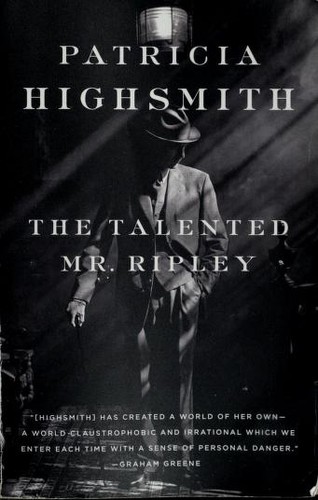
The Talented Mr. Ripley by Patricia Highsmith is a 1955 thriller book about identity and reinvention, class anxiety, amorality and charm. Highsmith inverts the standard moral contract of crime fiction: Ripley is the protagonist, not the detective, and the novel generates suspense from wanting him to escape, not be caught.
Summary
Tom Ripley is a small-time con man in New York, barely surviving on petty fraud, when a chance encounter leads a wealthy shipbuilder to hire him as an emissary: go to Italy, find my son Dickie, bring him home. Ripley has never met Dickie Greenleaf, but within weeks of arriving in the sun-soaked idleness of the Italian coast he is obsessed — not with completing the errand, but with becoming Dickie. What follows is not a conventional thriller but something stranger and more psychologically disturbing: a study in how a certain kind of person can will themselves into any identity they need, and what it costs.
Highsmith is not interested in giving you a villain to root against. Ripley is the center of the novel, and she writes him with full interiority — his anxieties, his acute social intelligence, his casual capacity for violence, his genuine aesthetic sensibility, and his relentless calculation about how to survive exposure. The crimes, when they come, are not staged for shock but presented with the same flat matter-of-factness as everything else in Ripley's inner life. That tonal flatness is the novel's most unsettling achievement.
What distinguishes Highsmith from her contemporaries is her refusal to moralize. Ripley is never punished in the ways genre convention demands. The novel's moral universe is not absent — it is present in the reader's discomfort — but it refuses to deliver the satisfying retribution that separates crime fiction from literature. Ripley Gets Away is the implicit subtitle of every novel in the Ripley series, and Highsmith understood that this refusal was more honest about how the world works than any tidy resolution.
Readers who want a crisp thriller plot with a satisfying ending will find this unsatisfying almost by design. Readers willing to sit with an antihero whose company they both enjoy and mistrust will find one of the twentieth century's most durable psychological portraits. It is not a comfortable book, but it is a precise one.
Talk to The Talented Mr. Ripley like its author wrote you back.
Get the ideas that fit your life — not generic summaries.
- Chat with the book
- Audiobook-style main ideas
- Adapts to your life and goals
- Helps you take action
Key takeaways
- 1.
Highsmith inverts the standard moral contract of crime fiction: Ripley is the protagonist, not the detective, and the novel generates suspense from wanting him to escape, not be caught.
- 2.
Identity is entirely performable in Highsmith's world. Ripley has no stable self, which is both his method and his tragedy — he envies Dickie because Dickie seems to have a self worth inhabiting.
- 3.
Class anxiety drives the novel as much as psychology does. Ripley's crimes are almost all about acquiring the life he believes he deserves but was denied by accident of birth.
- 4.
Violence in Highsmith is practical, not spectacular — it solves a problem and is folded back into ordinary life. The absence of guilt is the most disturbing element.
- 5.
The novel argues that charm is a form of intelligence, and that social performance is a kind of talent — one Ripley possesses in excess and uses without conscience.
- 6.
Highsmith's Italy is both beautiful and morally permissive: the expatriate world Ripley enters has its own suspended ethics, where wealth provides insulation from consequence.
- 7.
Ripley's relationship with Dickie involves desire that Highsmith leaves deliberately ambiguous — the homoeroticism is present in every scene but is never explicitly resolved.
- 8.
The refusal to punish Ripley is a formal argument: the world does not correct injustice reliably, and fiction that pretends otherwise is less honest than fiction that doesn't.
Discussion questions
Use these on your own, with a book club, or as chat starters in Superbook. Book club version, ready to copy or print →
- 1.
Highsmith puts you inside Ripley's head for the entire novel. At what point, if ever, did you stop wanting him to get away?
- 2.
Ripley kills Dickie not out of rage but out of calculation — a practical solution to an acute problem. Does that make the act more or less disturbing than crimes of passion?
- 3.
The novel is set in postwar Italy among American expatriates with enough money to live without working. How does that world make Ripley's crimes possible — or does it actively invite them?
- 4.
Ripley's desire for Dickie is part envy, part imitation, and part something else. How did you read the homoeroticism, and does making it explicit change the novel?
- 5.
Compared to American Psycho or We Need to Talk About Kevin, which also use first-person antihero narration, does Highsmith earn her antihero more fully — or is the lack of explicit moral reckoning a cop-out?
- 6.
Ripley is aesthetically refined — he appreciates art, architecture, music. Does his genuine sensibility make him more or less disturbing as a killer?
- 7.
The novel ends with Ripley free and comfortable. Is that a critique of how wealth protects crime, a nihilist shrug, or something else?
- 8.
Freddie Miles and Herbert Greenleaf both get close to the truth. What stops them from finding it? Is it incompetence, or does Highsmith suggest something about how badly people want comfortable explanations?
- 9.
In Cold Blood (also 1955-era crime) treats its killers with sympathy and produces moral discomfort. Where does Highsmith's discomfort land differently from Capote's?
- 10.
Ripley has no stable identity. Is that a condition he was born with, or does Highsmith suggest it's something the class system creates in people left outside it?
- 11.
The Ripley series runs to five novels. Having read the first, do you want to keep following a character who will never change and never be punished?
- 12.
If the novel had ended with Ripley caught and convicted, would it be a better book — or would that ending be false to what Highsmith is arguing about the world?
Themes
Frequently asked questions
-
Is The Talented Mr. Ripley worth reading?
Yes, though it helps to know what kind of book you're picking up. It's not a thriller in the conventional sense — there is no detective, no satisfying punishment, no moral resolution. It is a psychological study of a particular kind of person, and its power comes from discomfort rather than plot momentum.
-
Is it hard to read?
No — it reads quickly and smoothly. The difficulty is not stylistic but moral: Highsmith writes Ripley with enough interiority that readers often find themselves rooting for someone they know they shouldn't. That psychological friction is the book's point.
-
Who shouldn't read it?
Readers who require moral resolution from their crime fiction. If an antihero who escapes all consequences feels like a broken contract with the reader rather than a formal argument, Highsmith's entire Ripley series will frustrate you. Christie will serve you better.
-
Is the film adaptation worth watching?
Anthony Minghella's 1999 film with Matt Damon is excellent and partially faithful, though it adds a moral weight the novel deliberately withholds. Watching it after reading is useful precisely because the differences reveal what Highsmith was insisting on.
-
Is there a sequel?
Yes — four of them. Ripley Under Ground, Ripley's Game, The Boy Who Followed Ripley, and Ripley Under Water continue his story. The character never reforms and the moral universe never corrects. Ripley Under Ground is the strongest of the four sequels.
Similar books
In Cold Blood
Truman Capote
The Confidence Game: Why We Fall for It Every Time
Maria Konnikova
Bad Blood: Secrets and Lies in a Silicon Valley Startup
John Carreyrou
1984
George Orwell
