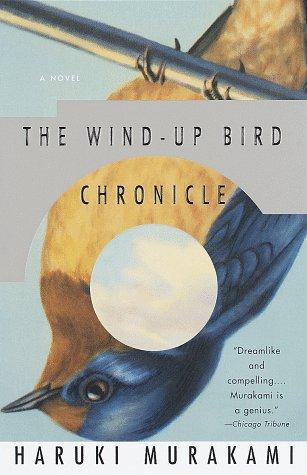
The Wind-Up Bird Chronicle by Haruki Murakami is a 1994 literary fiction book about identity and dissolution, war and collective memory, the unconscious. The dry well that Toru descends repeatedly is the novel's controlling image: going down into the self, into darkness, into the place where ordinary identity dissolves, is both dangerous and necessary.
Summary
The Wind-Up Bird Chronicle begins as a novel about small domestic disruptions — Toru Okada's cat has gone missing, and then his wife Kumiko goes missing in a different way. But Murakami's characteristic move is to open these domestic rifts outward until they become chasms between worlds. Over the novel's enormous length, Toru descends into a dry well, meets a series of peculiar people who seem to know things about him that he doesn't know himself, and gradually discovers that his unremarkable marriage was never what it appeared to be, and that the violence embedded in Japan's 20th-century history is somehow still moving through the present.
The novel has several major strands that don't obviously belong together. There are the meditative present-day chapters following Toru's increasingly strange domestic investigation. There are two extraordinary World War II narratives — one set in Mongolia during the Nomonhan incident of 1939, another in a Manchurian zoo — that rank among the darkest and most powerful writing Murakami has produced. There is a sinister political figure named Noboru Wataya who represents something about postwar Japan's accommodation with power. And there are dreamlike encounters that operate in the space where the living touch the dead.
This is Murakami's most ambitious novel and, for many readers, his best — the one that most fully embodies what he is actually trying to do. The mixture of the banal and the uncanny, of pop culture lightness and wartime horror, of personal and historical, is harder to dismiss here than in his shorter books. The WWII sections are not ornaments — they are the novel's argument that Japan has not reckoned with what it did, and that the unacknowledged past deforms the present in ways that cannot be fixed by simple domestic competence.
It is also very long and deliberately digressive, and some readers lose the thread. The novel's structure is associative rather than causal — things connect sideways rather than forward. This is either a feature or a fatal flaw depending on your tolerance for sustained ambiguity. For readers willing to commit the time and attention it demands, The Wind-Up Bird Chronicle is the most rewarding novel in Murakami's catalog.
Talk to The Wind-Up Bird Chronicle like its author wrote you back.
Get the ideas that fit your life — not generic summaries.
- Chat with the book
- Audiobook-style main ideas
- Adapts to your life and goals
- Helps you take action
Key takeaways
- 1.
The dry well that Toru descends repeatedly is the novel's controlling image: going down into the self, into darkness, into the place where ordinary identity dissolves, is both dangerous and necessary.
- 2.
The World War II sections are not surrealist — they are specific, brutal, and historical. Murakami is insisting that Japan's present cannot be understood without its past.
- 3.
Kumiko's disappearance is also a discovery: the person you thought you knew most completely may have been a kind of stranger. The novel is honest about how much intimacy can fail to see.
- 4.
Noboru Wataya is the novel's villain in a way that goes beyond personal antagonism: he represents the capacity to manipulate and consume other people, and his political success is Murakami's critique of something specific in postwar Japanese culture.
- 5.
Toru's ordinariness is the point — the novel follows a nobody, a man with no particular qualities, into an extraordinary confrontation. What is at stake for him is the question of whether ordinary people can act in the face of evil.
- 6.
May Kasahara, the teenager who observes the neighborhood from her bedroom window, offers the novel's most detached perspective — she sees what Toru cannot because she is not invested in it.
- 7.
The wind-up bird of the title is heard but never seen: it winds up the spring of the world. This mysterious mechanical avian is one of Murakami's most resonant images.
- 8.
The novel refuses closure: Toru finds Kumiko, but what he finds is not what was lost, and the ending is a new beginning rather than a resolution.
Discussion questions
Use these on your own, with a book club, or as chat starters in Superbook. Book club version, ready to copy or print →
- 1.
The Nomonhan sections are historically specific and brutally realistic in a way that feels different from the rest of the novel. What do you think Murakami is arguing by placing that history inside this story?
- 2.
Lieutenant Mamiya and his experience in the dry well in Mongolia is the novel's most extreme test of what happens to a person who stares into nothing. What does the novel think he found?
- 3.
Toru is passive for most of the novel — things happen to him; he rarely initiates. Is that a character flaw, a thematic choice, or a critique of a certain kind of Japanese masculinity?
- 4.
Noboru Wataya is a successful political figure despite being portrayed as fundamentally corrupt and empty. Does that satire feel specific to Japan, or does it land more universally?
- 5.
Kumiko's letters, when they finally arrive, reframe the marriage completely. Did you find her explanation convincing? Does Toru?
- 6.
May Kasahara disappears from the novel and then returns in letters. What does her arc add — is she essential to the novel's argument, or does she feel like a loose end?
- 7.
The novel has three separately published Japanese volumes. Jay Rubin's English translation is a condensed version of all three. Does knowing that affect how you think about the structural looseness?
- 8.
The wind-up bird is heard but never explained. What do you think it means — or is the question wrong?
- 9.
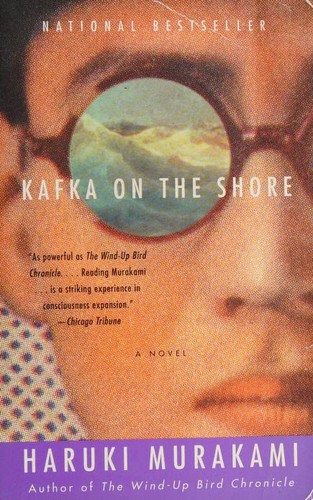
How does this novel compare to Kafka on the Shore as an exploration of the same Murakami territory — the domestic surface cracking open to reveal something older and darker?
- 10.
Toru finds himself in a confrontation with Noboru Wataya that is both literal and metaphysical. Does the resolution of that confrontation satisfy you, or feel evasive?
- 11.
The novel was published in 1994, during Japan's post-bubble economic stagnation. Does knowing the historical moment change how you read Toru's purposeless domestic life?
- 12.
What is the novel's view of marriage? Is it possible to know another person, or is intimacy always, at some level, projection?
Themes
Frequently asked questions
-
Is The Wind-Up Bird Chronicle Murakami's best novel?
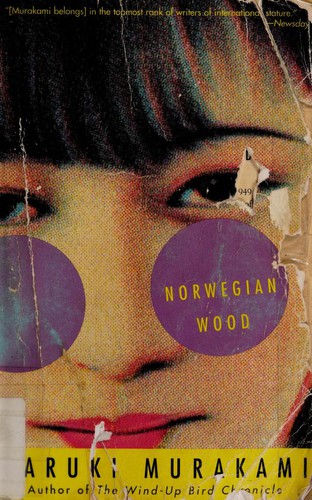
Many readers and critics think so. It's the most ambitious and the most complete realization of what Murakami is trying to do — combining the banal with the metaphysical, the personal with the historical. It is also his longest and most demanding. If you're new to Murakami, Norwegian Wood may be an easier entry point, but this is the one to build toward.
-
What is The Wind-Up Bird Chronicle about, without spoilers?
A Tokyo man with no particular ambitions searches for his missing cat and then his missing wife, and in the process encounters a series of strange people who seem connected to something dark in Japan's wartime past. It's about identity, history, marriage, and the violence that gets buried beneath ordinary life.
-
Is The Wind-Up Bird Chronicle hard to read?
It's long (nearly 600 pages) and deliberately associative in structure — things connect sideways rather than causally. The World War II sections are harrowing. The surrealist elements require you to stop trying to explain and just follow. Patient readers who enjoy that kind of immersive ambiguity will love it. Readers who need clear causation and resolution will struggle.
-
Do I need to read Murakami's other novels first?
No. The Wind-Up Bird Chronicle is entirely self-contained. Some readers come to it first and others after Norwegian Wood or Kafka on the Shore. It rewards being read on its own terms.
-
Who shouldn't read The Wind-Up Bird Chronicle?
Readers who need plot to resolve cleanly. The novel is very long, deliberately fragmented, and refuses to explain its own metaphysics. The World War II torture and execution scenes are also genuinely brutal — readers sensitive to graphic violence should be prepared.