Witness for the Prosecution and Other Stories by Agatha Christie is a 1948 short stories book about deception and misdirection, justice and its limits, gender and underestimation. The title story is one of the most technically perfect pieces of misdirection in English crime writing — it earns its twist because the clues were genuinely there.
Summary
Witness for the Prosecution collects some of Agatha Christie's finest short fiction, anchored by the title story: a courtroom thriller in which a barrister defending a man accused of murder finds his confidence undermined by one of the most audacious plot reversals in crime fiction. The collection includes a dozen other stories, among them The Mysterious Mr. Quin, Philomel Cottage, and SOS, each demonstrating Christie's range across the mystery form — from locked-room puzzles to psychological suspense to stories with an almost supernatural atmosphere.
The title story alone justifies the collection. "Witness for the Prosecution" is a masterclass in misdirection: Christie uses a narrator whose complacency mirrors the reader's, and then she pulls the rug so completely that rereading reveals just how many signals were there all along. The story has been adapted for stage, film, and television multiple times — most memorably in Billy Wilder's 1957 film — because its mechanism is both elegant and emotionally satisfying in a way that pure puzzle plotting rarely achieves.
What distinguishes Christie's short fiction from her novels is compression. The stories have no room for subsidiary characters or red herrings for their own sake. Every element earns its place. The atmosphere in stories like "Philomel Cottage" — where a woman gradually realizes her new husband is not who he claims to be — is genuinely unsettling in ways Christie's longer work sometimes isn't. These stories remind you that Christie's real subject was not murder but human self-deception: the lies we tell ourselves that make us miss the obvious.
For readers new to Christie, this is a better entry point than the longer Poirot novels. For long-time readers, the collection offers Christie stripped to her most essential mechanisms. The stories date to the 1920s-40s and carry the class assumptions of that era; modern readers will notice them, but they don't undermine the craft.
Talk to Witness for the Prosecution and Other Stories like its author wrote you back.
Get the ideas that fit your life — not generic summaries.
- Chat with the book
- Audiobook-style main ideas
- Adapts to your life and goals
- Helps you take action
Key takeaways
- 1.
The title story is one of the most technically perfect pieces of misdirection in English crime writing — it earns its twist because the clues were genuinely there.
- 2.
Christie's central subject across these stories is human self-deception: characters who miss obvious truths because they're too comfortable, too vain, or too in love.
- 3.
The stories demonstrate that the short form rewards different techniques than the novel — compression creates a kind of narrative pressure that longer work can diffuse.
- 4.
Gender is a consistent source of Christie's misdirection: characters routinely underestimate women, and the stories exploit that underestimation as their mechanism.
- 5.
Christie's detectives succeed not through superior intelligence but through superior attention — they notice what others dismiss as irrelevant.
- 6.
The atmosphere in stories like 'Philomel Cottage' shows Christie could write genuine psychological horror when she chose to, not just puzzle-making.
- 7.
Multiple stories hinge on the gap between how people appear in social contexts and who they actually are — a concern Christie returned to throughout her career.
- 8.
These stories hold up not because the plots are timeless but because the human behaviors they illuminate are: vanity, self-deception, the desire to believe comfortable things.
Discussion questions
Use these on your own, with a book club, or as chat starters in Superbook. Book club version, ready to copy or print →
- 1.
The title story's twist depends on readers making exactly the same assumptions its narrator does. Did you catch it on first reading, and what does your answer say about how you read mysteries?
- 2.
Christie repeatedly uses her characters' underestimation of women as a plot mechanism. Is that a critique of the attitude or an exploitation of it — or both?
- 3.
Which story in the collection felt most modern to you? Which felt most dated, and in what specific ways?
- 4.
Christie's detectives are famously attentive to human behavior over physical evidence. What does that approach imply about her view of criminal psychology?
- 5.
The stories were written between the wars and into the 1940s. How much does knowing that context change how you read the class dynamics and gender dynamics on the page?
- 6.
'Philomel Cottage' could be read as a thriller or as a story about domestic danger. Which reading did you find more compelling?
- 7.
Christie's short fiction is almost entirely free of moral ambiguity — the guilty are identified and punished. Is that satisfying, or does it feel like a limitation?
- 8.
The title story has been adapted for stage, film (Wilder, 1957), and television multiple times. Why do you think this particular story keeps drawing adapters back?
- 9.
Compared to contemporary crime writers — Tana French, Kate Atkinson — what is Christie still doing that they can't or don't?
- 10.
What does the collection suggest Christie thought justice was for? Is she a moralist, or just a puzzle-maker?
- 11.
Several stories feature characters who almost get away with it. Does Christie have sympathy for them, or is she strict about moral accounting?
- 12.
If you had to assign one story from the collection as required reading for a course on misdirection in fiction, which would you pick and why?
Themes
Frequently asked questions
-
Is Witness for the Prosecution a short story or a novel?
The title piece is a short story, first published in 1925. This collection bundles it with a dozen other Christie short stories. The story was later adapted into a stage play and then a film; the play and film are longer and somewhat different from the original story, though the central twist is the same.
-
Should I read this collection before or after other Christie novels?
Either works. The stories feature neither Poirot nor Miss Marple (mostly), so you don't need familiarity with those series. The collection is actually a good entry point into Christie's work because the short form shows her core techniques in compressed form.
-
Is the 1957 Billy Wilder film worth watching alongside the story?
Yes — and arguably the film surpasses the story. Wilder adds a framing device with the barrister's nurse and benefits enormously from Charles Laughton and Marlene Dietrich. Watch it after reading; it's one of the great courtroom films.
-
Who shouldn't read this collection?
Readers who find Golden Age mystery conventions — the country houses, the class hierarchies, the tidy moral accounting — frustrating or dated will struggle here. Christie isn't interested in psychological realism in the contemporary sense. If you want moral ambiguity, look elsewhere.
-
How does Christie create suspense when everyone knows she's famous for twists?
By making you certain you've spotted the trick — and then having spotted a different trick entirely. The misdirection operates on two levels: the characters' and the readers'. The title story works even when you know it's coming because the mechanism of deception is itself fascinating.
Similar books
In Cold Blood
Truman Capote
The Spy and the Traitor: The Greatest Espionage Story of the Cold War
Ben Macintyre
Helter Skelter: The True Story of the Manson Murders
Vincent Bugliosi and Curt Gentry
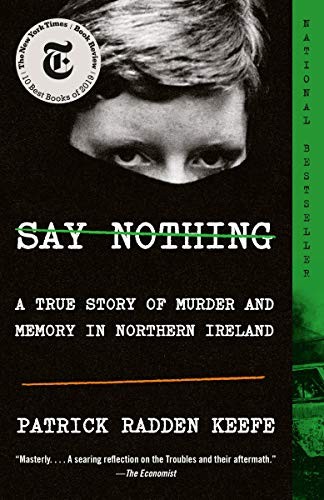
Say Nothing: A True Story of Murder and Memory in Northern Ireland
Patrick Radden Keefe
