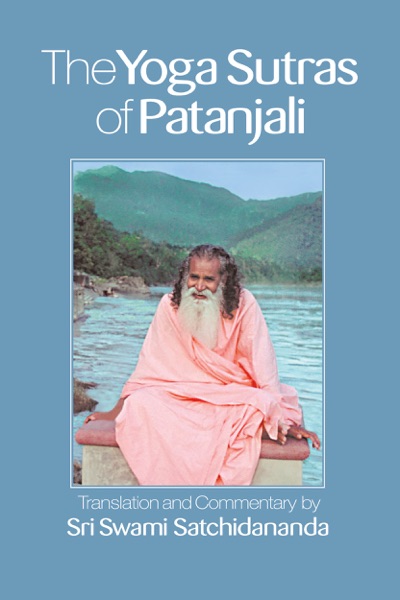
The Yoga Sutras of Patanjali by trans. Sri Swami Satchidananda is a 1978 religion & spirituality book about yoga philosophy, mind and consciousness, meditation. Yoga is defined as the cessation of mental fluctuations, not as physical exercise. The asana practice familiar in modern gyms is one of eight limbs, and a preparatory one at that.
Summary
The Yoga Sutras is a foundational text of classical Indian philosophy, compiled by the sage Patanjali — likely around 400 CE, though some scholars place the compilation earlier or later. The text consists of 196 short aphorisms (sutras) organized into four chapters (padas), covering the nature of mind, the practice of yoga, the powers that arise from deep practice, and the state of liberation. This edition, translated and commented by Swami Satchidananda and first published in 1978, has become one of the most widely used introductions to the text in the Western world.
Patanjali defines yoga in the second sutra with a single Sanskrit phrase: "Yoga chitta vritti nirodha" — yoga is the cessation of the fluctuations of the mind. Everything else in the text is either the elaboration of what that means or the practical description of how to achieve it. The five types of mental modifications (vrittis) are identified and analyzed: correct knowledge, incorrect knowledge, verbal knowledge, sleep, and memory. All of them, including correct knowledge, are modifications that yoga seeks to still.
The second chapter presents Patanjali's "eight limbs" (ashtanga) of yoga: ethical restraints (yamas), ethical observances (niyamas), posture (asana), breath regulation (pranayama), sense withdrawal (pratyahara), concentration (dharana), meditation (dhyana), and absorption (samadhi). The five yamas include non-violence, truthfulness, non-stealing, sexual restraint, and non-possessiveness. The presentation is rigorous and systematic: each limb is a prerequisite for the next, and the whole path is described as a graduated practice toward the complete stilling of the mind and the recognition of the distinction between pure awareness (purusha) and matter (prakriti).
Satchidananda's commentary is warm, accessible, and frequently brings the sutras into contact with daily life. He draws connections to other Indian traditions and occasionally to Western thought. Readers seeking strictly academic commentary may prefer other editions; those seeking a lived practice context will find his voice unusually helpful. The text is compact — a serious reading of the sutras and commentary takes only a few hours — but the material rewards repeated return over many years.
Talk to The Yoga Sutras of Patanjali like its author wrote you back.
Get the ideas that fit your life — not generic summaries.
- Chat with the book
- Audiobook-style main ideas
- Adapts to your life and goals
- Helps you take action
Key takeaways
- 1.
Yoga is defined as the cessation of mental fluctuations, not as physical exercise. The asana practice familiar in modern gyms is one of eight limbs, and a preparatory one at that.
- 2.
The mind's natural state, according to Patanjali, is turbulence. All five types of mental modification — including correct knowledge — are fluctuations that cloud the recognition of pure awareness.
- 3.
The eight-limbed path (ashtanga yoga) is a sequential practice: ethical conduct before posture, posture before breath control, breath control before meditation. Each stage prepares the conditions for the next.
- 4.
Non-violence (ahimsa) is the root of the ethical framework. Patanjali lists it first among the yamas and the commentary tradition regards all other ethical principles as applications of it.
- 5.
Samadhi — complete absorption — is not a single state but a progressive deepening. The early stages retain content (an object of focus); the deepest stages release all content and approach the recognition of pure consciousness.
- 6.
The siddhis — extraordinary powers that arise from deep practice — are explicitly described and then explicitly set aside as distractions. Attachment to powers is itself an obstacle to liberation.
- 7.
Prakriti (matter, including the mind and body) and purusha (pure awareness) are distinct. Liberation is the recognition that awareness has never been bound by matter, only appeared to be.
- 8.
Satchidananda's commentary consistently grounds the sutras in daily life, making the philosophical framework applicable to practical situations rather than reserved for monastics.
Discussion questions
Use these on your own, with a book club, or as chat starters in Superbook. Book club version, ready to copy or print →
- 1.
Patanjali defines yoga as the cessation of mental fluctuations, not physical practice. How does that definition compare to what you thought yoga was, and does it change how you think about the purpose of practice?
- 2.
The five yamas (ethical restraints) are presented as foundational to everything else in the path. How does non-violence function as the root from which the other restraints follow?
- 3.
Patanjali includes correct knowledge among the five mental modifications to be stilled. What does it mean that even accurate perception is a form of turbulence that yoga seeks to transcend?
- 4.
The eight limbs are presented as sequential prerequisites. Do you think it's actually possible to practice later limbs (meditation, samadhi) without firmly establishing the earlier ones (ethical restraints, posture)?
- 5.
Satchidananda's commentary frequently connects the sutras to daily life. Which of those connections did you find most useful or surprising?
- 6.
The siddhis (powers) are described and then explicitly dismissed as distractions. What does it mean that extraordinary ability can itself be an obstacle to deeper development?
- 7.
Patanjali's cosmology distinguishes purusha (pure awareness) from prakriti (matter). How does that distinction compare to mind-body distinctions you encounter in Western philosophy or religion?
- 8.
The sutras say that liberation is the recognition that awareness was never actually bound — it only appeared to be. Does that claim feel like a meaningful insight or a philosophical sleight of hand?
- 9.
Pratyahara (sense withdrawal) is the fifth limb — the bridge between the outer and inner practices. How do you understand the relationship between disciplining physical behavior and achieving inner stillness?
- 10.
The text was compiled around 400 CE but claims to describe a timeless technology of mind. Which aspects of the system seem genuinely universal, and which seem specific to a particular cultural and historical context?
- 11.
How does the Yoga Sutras' approach to suffering — as arising from the mind's mistaken identification with matter — compare with other frameworks for understanding and addressing human suffering that you know?
Themes
Frequently asked questions
-
Do I need to practice yoga to read the Yoga Sutras?
No. The text is philosophical and practical but not a physical instruction manual. It describes a comprehensive psychology and ethics of mind that stands independently of whether the reader practices asana.
-
Is this a difficult text to read?
The sutras themselves are extremely compressed — some are only a few words long. Satchidananda's commentary makes them accessible to general readers. The philosophical framework is unfamiliar to most Western readers, but the concepts are explained progressively.
-
What is the most important idea in the Yoga Sutras?
That the mind's fluctuations obscure the recognition of pure awareness, and that a systematic practice of ethical conduct, physical discipline, and meditation can progressively still those fluctuations. Liberation is the fruit of sustained, integrated practice.
-
How does this translation compare to others?
Satchidananda's translation is warm and accessible, with extensive commentary that connects the sutras to daily life. It is not the most scholarly edition — readers wanting rigorous philological treatment might prefer Georg Feuerstein's or Edwin Bryant's versions. But for a practitioner's entry point, it is widely recommended.
-
Who should read the Yoga Sutras?
Anyone interested in classical Indian philosophy, meditation practice, or the psychology of attention and consciousness. Also useful for serious practitioners of yoga who want to understand the philosophical tradition behind the physical practice.