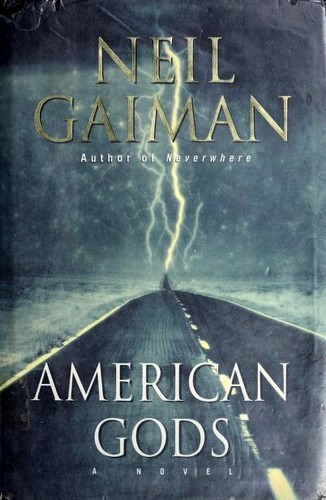
American Gods by Neil Gaiman is a 2001 fantasy book about immigration and belonging, belief and its power, old versus new. America is a bad place for gods. Gaiman's central conceit — that immigrant belief carries gods across the ocean and American assimilation destroys them — is the most useful metaphor in the book.
Summary
American Gods opens with Shadow Moon, a man released from prison days early because his wife has died in a car accident. He takes a job as bodyguard and driver for a man who calls himself Wednesday — a con artist who turns out to be the American manifestation of Odin — and is pulled into a gathering conflict between the old gods, brought to America by waves of immigrants who carried their beliefs with them, and the new gods of technology, media, and corporate power.
The novel is about what America does to the people and the ideas it imports. The old gods are diminished, exhausted, running scams and working small-town jobs because the immigrant communities that once sustained them have dissolved or been absorbed. They are not impressive figures — Anansi sells suits in a failing shop, Czernobog worked in a Chicago slaughterhouse, Vulcan runs a gun factory in a southern town. The gap between what they were and what America made them is the book's central image, and Gaiman uses it to say something real about assimilation, cultural memory, and the peculiarly American talent for grinding down what arrives here.
Gaiman writes with the authority of someone who has read widely in mythology but has fully absorbed it rather than merely deployed it. The novel's structure is novelistic — Shadow's road trip through small-town America gives it a Steinbeck-ish texture — and the interspersed mythological "Coming to America" vignettes work both as backstory and as a sustained argument about the book's themes. The prose is controlled and atmospheric without tipping into purple.
This is a long book and a patient one. Shadow is deliberately enigmatic as a protagonist, which some readers find compelling and others find thin. The plot's momentum is uneven — the middle sags — and the resolution requires the reader to have bought into the mythological framework completely. For readers who have, the ending is emotionally substantial. For readers who find mythology-based fantasy hard to invest in emotionally, the book may feel more clever than moving.
Talk to American Gods like its author wrote you back.
Get the ideas that fit your life — not generic summaries.
- Chat with the book
- Audiobook-style main ideas
- Adapts to your life and goals
- Helps you take action
Key takeaways
- 1.
America is a bad place for gods. Gaiman's central conceit — that immigrant belief carries gods across the ocean and American assimilation destroys them — is the most useful metaphor in the book.
- 2.
The new gods of media, internet, and technology are presented as no more or less worthy than the old ones. They're just better at attention capture. Gaiman doesn't romanticize the old.
- 3.
Wednesday/Odin is one of the great trickster characters in modern fiction — all the charm of a con man and all the coldness of a deity.
- 4.
Small-town America in this novel is presented with a strange affection. The diners and motels and fading town squares are as mythological as anything Gaiman invents.
- 5.
The 'Coming to America' interludes are formally the most interesting sections. Gaiman captures how a god arrives and then gets left behind as the community that carried it disperses.
- 6.
Shadow's blankness is structural, not accidental. He's a man defined by loss, and the novel is partly about whether a person can be more than what happened to them.
- 7.
The war between old and new gods is a frame for something simpler: the question of what survives in America across generations, and the answer is mostly: nothing, transformed beyond recognition.
- 8.
Gaiman uses America's roadside weirdness — the World's Largest Attractions, the Mystery Spots — as evidence for a country built on spectacle and forgetting.
Discussion questions
Use these on your own, with a book club, or as chat starters in Superbook. Book club version, ready to copy or print →
- 1.
Wednesday tells Shadow that America is a 'bad land for gods.' Do you think Gaiman's argument extends to immigrant cultures more broadly, or is it specific to mythology?
- 2.
The old gods are diminished and largely pathetic. Does that make them sympathetic or does it expose the nostalgia in the conceit?
- 3.
Shadow is deliberately not a rounded character in the conventional sense. Does that choice serve the novel, or does it mean you can't invest in him?
- 4.
The new gods of media and internet are mostly contemptible in the novel. Is that a fair critique of technology culture or Gaiman being a romantic about old things?
- 5.
Which of the 'Coming to America' vignettes stayed with you longest, and why?
- 6.
The novel is set mostly in small towns and on roads. How does that Americana landscape function thematically — is it just atmosphere or is it doing structural work?
- 7.
Wednesday/Odin is a con man and a war god. The book treats those as the same thing. Do you agree with that equivalence?
- 8.
The ending reveals the whole conflict was a setup. Does that reframe what came before in an interesting way, or does it feel like a cheat?
- 9.
What does the novel say about memory — cultural, personal — and the cost of forgetting where you came from?
- 10.
How does American Gods compare to Gaiman's other work you've read, if any? Does knowing his range change how you read this?
- 11.
The book was published in 2001. Does the critique of the new gods of media feel different now that the internet has become what it became?
- 12.
Anansi, Czernobog, and Bilquis are all portrayed with genuine weight alongside Wednesday. Which god's American story interested you most?
Themes
Frequently asked questions
-
Is American Gods worth reading?
Yes, especially if you have any interest in mythology, Americana, or the question of what happens to immigrants' cultural identities. It's uneven in the middle but the conception is ambitious and executed with real skill. It belongs in the same conversation as the best speculative fiction of the early 2000s.
-
Is American Gods hard to follow?
No — the plot is straightforward, a classic road-trip and gathering-storm structure. The challenge is that the novel expects some familiarity with the mythological figures it draws on; readers who don't recognize Anansi or Czernobog on sight may want to keep notes or look things up.
-
What is the main idea of American Gods?
That America destroys the beliefs its immigrants bring with them, leaving the gods those beliefs sustained diminished and stranded. Against them Gaiman sets the new gods of media and technology — but doesn't suggest they're an improvement.
-
Who shouldn't read American Gods?
Readers who need consistent narrative momentum will find the middle sections slow. Readers who want a protagonist with a strong interiority will find Shadow's blankness frustrating. Readers who dislike mythology-based fantasy should probably start with Gaiman's shorter work.
-
Is there a TV adaptation?
Yes — a Starz TV series adapted American Gods for three seasons starting in 2017. It's visually striking and well-cast but changes the material significantly, particularly in later seasons. It was cancelled before completing the story.