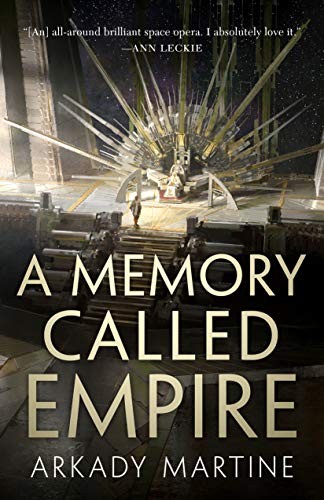
A Memory Called Empire by Arkady Martine is a 2019 science fiction book about cultural assimilation and resistance, imperial power, identity and memory. The novel's central argument is that loving an empire's culture does not protect you from what the empire does with you — admiration and colonization can be simultaneous experiences.
Summary
Mahit Dzmare, ambassador from a small, semi-independent mining station to the vast Teixcalaanli Empire, arrives at the capital to find her predecessor has died under suspicious circumstances and the neural implant that was supposed to give her access to his memories and knowledge is three years out of date. She is alone in an empire she has adored from a distance her entire life — its literature, its aesthetics, its politics — and the story of how she navigates that contradiction is A Memory Called Empire's real subject, more than the murder mystery that drives the plot.
Arkady Martine is a historian of the Byzantine Empire by academic training, and that background shows in the texture of Teixcalaan. The empire is not a metaphor for Rome or the British empire; it is a distinct civilization with its own logic, aesthetics, and assumptions, and it is genuinely compelling to inhabit. The problem of imperialism is never posed as a simple moral: Teixcalaan is beautiful, and Mahit's love for it is sincere, and that love is itself a form of colonial capture. The novel is unsparing about this without making Mahit a symbol of it.
The pacing is unusual for space opera — slower, more attentive to social and political texture, more interested in what rooms feel like and what conversations mean than in action sequences. The mystery is competent, but the real pleasures are the relationship between Mahit and her cultural liaison Three Seagrass (bright, well-meaning, unreliable, oblivious to her own condescension), and the meditation on what it means to love a culture that doesn't love you back, that sees you as a provincial at best and raw material at worst.
The book won the Hugo Award for Best Novel in 2020 and its sequel, A Desolation Called Peace, also won the following year. Some readers will find the pacing too slow and the mystery too slight for a thick science fiction novel. Readers who want their genre fiction to do the work literary fiction does — to think carefully about its world and what it implies — will find A Memory Called Empire one of the most rewarding SF debuts of the decade.
Talk to A Memory Called Empire like its author wrote you back.
Get the ideas that fit your life — not generic summaries.
- Chat with the book
- Audiobook-style main ideas
- Adapts to your life and goals
- Helps you take action
Key takeaways
- 1.
The novel's central argument is that loving an empire's culture does not protect you from what the empire does with you — admiration and colonization can be simultaneous experiences.
- 2.
Mahit's neural implant technology — carrying the memories of her predecessors — serves as both plot mechanism and metaphor for the question of continuous identity across different versions of a self.
- 3.
Teixcalaan is fully realized as a distinct civilization; Martine's historical scholarship shapes a culture with genuine internal coherence rather than a mapped-on Earth analog.
- 4.
Three Seagrass is the book's subtlest character: genuinely caring, genuinely oblivious to her own imperial assumptions, and impossible to simply condemn because she is impossible to simply dismiss.
- 5.
Language is treated as a form of power throughout — naming conventions, the structure of Teixcalaanli poetry, the way empire colonizes through culture before it colonizes through force.
- 6.
The mystery structure gives the novel forward motion, but the real investigation is not into who killed the previous ambassador but into what Teixcalaan wants from Lsel Station and what that wanting costs.
- 7.
Martine refuses to give Mahit a clean answer to the question of assimilation: the novel ends with the question sharpened, not resolved.
- 8.
The book demonstrates that pace is not the same as stakes — the slow, attentive prose accumulates tension differently from action-forward SF, but the tension is real.
Discussion questions
Use these on your own, with a book club, or as chat starters in Superbook. Book club version, ready to copy or print →
- 1.
Mahit loves Teixcalaanli culture deeply and arrives in the empire knowing it doesn't see Lsel Station as a full partner. Is that a contradiction she can live with, and does the novel think she should?
- 2.
Three Seagrass is Mahit's closest ally and also the embodiment of the empire's casual imperial condescension. How does Martine want you to feel about her, and does the novel succeed?
- 3.
The neural implant technology raises questions about continuity of identity: is Mahit-with-Yskandr the same person as Mahit-without-Yskandr? Does the novel take a position?
- 4.
Teixcalaan is clearly a civilization influenced by Byzantine history. Does knowing that make the world-building richer, or does the academic substrate show in ways that interfere with the fiction?
- 5.
The murder mystery is not especially difficult to follow, and the solution is not especially surprising. Is that a flaw, or is the mystery a structural device for something more interesting?
- 6.
The novel is interested in imperial aesthetics — the beauty of Teixcalaanli culture — as a form of soft power. Do you think that argument is well-supported by what Mahit experiences?
- 7.
Complicity is a recurring theme: Mahit takes actions that help the empire even as she is trying to protect her station from it. Does the novel judge her for that, excuse it, or simply observe it?
- 8.
The pace is notably slower than most space opera. Did you find that a feature or a frustration, and what does Martine seem to believe deliberate pacing accomplishes?
- 9.
Lsel Station's own politics are gradually revealed to be more complicated than Mahit initially understood. Does that revelation change your reading of her mission?
- 10.
A Memory Called Empire is a debut novel. Where do you see the seams of a first book, and where is it fully accomplished?
- 11.
The sequel, A Desolation Called Peace, shifts perspective significantly. Based on this book, what would you expect the sequel to do, and what would you want it to do?
- 12.
The book won the Hugo in a year with strong competition. What do you think made it the consensus choice, and do you think it deserved it?
Themes
Frequently asked questions
-
Is A Memory Called Empire worth reading if you don't usually like literary SF?
It depends on what you mean by literary SF. The book is not experimental in structure and has a genuine forward-moving plot. It is slower and more interested in social texture than most space opera. If you have liked Le Guin or Ann Leckie's Ancillary Justice, you will probably like this.
-
How does it compare to Ancillary Justice?
Both deal with empire, identity, and the experience of small entities in the orbit of vast civilizations. Ancillary Justice is tighter and more plot-driven; A Memory Called Empire is more interested in cultural texture and the psychology of assimilation. They are companion reads rather than substitutes.
-
Is it hard to read?
The prose is clear, but the novel rewards attention to detail and patience with deliberate pacing. The Teixcalaanli naming conventions (Three Seagrass, Twelve Azalea, Nineteen Adze) take a few chapters to become automatic. Nothing is deliberately difficult, but it is not a beach-read thriller.
-
Who shouldn't read A Memory Called Empire?
Readers who want fast-moving space opera with action sequences and high spectacle. The novel is fundamentally a political thriller and psychological portrait set against an SF backdrop; the SF elements serve the character work more than the other way around.
-
Do I need to read the sequel?
No — the novel has a complete arc. The sequel shifts to a different set of characters and a different part of the empire, and is better read after this one but is not required to resolve what this book sets up.