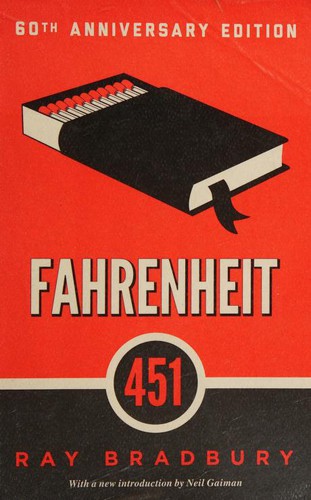
Fahrenheit 451 by Ray Bradbury is a 1953 science fiction book about censorship and knowledge, conformity versus dissent, memory and preservation. The most chilling detail in the novel is that the book-burning came from below, not above — citizens demanded relief from the discomfort of complexity long before the government institutionalized it.
Summary
Guy Montag is a fireman — which in Bradbury's future means a person who starts fires rather than puts them out. Books are illegal and the job of firemen is to burn them. Montag is satisfied with his work until he meets his strange, questioning neighbor Clarisse, and until the machinery of his comfortable life begins to reveal its hollow interior: his wife anesthetized by wall-sized television screens, a society that has traded depth for velocity, and a government that discovered it was easier to ban thinking than to punish thinkers.
Fahrenheit 451 is less a novel about censorship than about distraction. Bradbury's most prescient concern was not governments burning books but citizens choosing not to read them — choosing the flickering screens, the earbuds, the entertainment that requires nothing. The firemen emerged, the novel explains, not from state crackdown but from popular demand. A society that finds complex thought uncomfortable will eventually produce institutions that remove the sources of discomfort.
Bradbury's prose is incantatory and dense with imagery — deliberately at odds with the stripped and numbed language of the society he's depicting. The writing is sometimes overheated, reaching for profundity at moments where restraint would land harder. But at its best it produces passages that have lodged themselves in the language: the burning of books described with something close to ecstasy, the image of the Book People walking the railroad tracks, each person a living library.
The novel is short — closer to a novella — and reads in a few hours. Its brevity is appropriate; this is not a book that argues but one that evokes. Whether you find it profound or didactic probably depends on your tolerance for Bradbury's particular brand of romantic humanism. What is not in doubt is its cultural reach: it is one of the most widely read American novels of the twentieth century and its core anxiety feels more relevant now than when it was written.
Talk to Fahrenheit 451 like its author wrote you back.
Get the ideas that fit your life — not generic summaries.
- Chat with the book
- Audiobook-style main ideas
- Adapts to your life and goals
- Helps you take action
Key takeaways
- 1.
The most chilling detail in the novel is that the book-burning came from below, not above — citizens demanded relief from the discomfort of complexity long before the government institutionalized it.
- 2.
Mildred's wall-screens are the novel's most direct prophecy: immersive, interactive entertainment that substitutes for emotional connection and drains the capacity for reflection.
- 3.
Clarisse's function is to ask the kind of questions that make visible what Montag has normalized — she is not a character so much as a mirror.
- 4.
The Book People at the novel's end represent Bradbury's faith in memory as resistance: if you cannot preserve objects, you preserve meaning by becoming the object.
- 5.
Bradbury distinguishes between information and meaning: a society flooded with information but stripped of the contexts for interpreting it is not freer but more easily managed.
- 6.
Captain Beatty is the novel's most interesting character — a man who has read everything and understood nothing, or who understood too much and concluded that surrender was rational.
- 7.
The phoenix image at the end — humanity burning itself down and rebuilding — is Bradbury's most explicit statement about the cyclical nature of cultural destruction and renewal.
- 8.
The novel anticipates the attention economy by sixty years: its core insight is that distraction is not a side effect of entertainment but can be its primary function.
Discussion questions
Use these on your own, with a book club, or as chat starters in Superbook. Book club version, ready to copy or print →
- 1.
Bradbury said the novel is about television, not government censorship. Does that reading change how you interpret the firemen and the book-burning?
- 2.
Captain Beatty has memorized vast amounts of literature and uses it to justify burning books. Is he cynical, genuinely convinced, or something more complicated?
- 3.
Mildred chooses her screens over her husband without apparent conflict. Is she a victim of her society, or is Bradbury too comfortable placing all the blame on the technology?
- 4.
The novel's society didn't ban books through force but through social pressure and eventually law following demand. How does that account compare to how censorship actually works?
- 5.
The Book People at the end memorize books so they can be preserved after the destruction. Is that a hopeful ending or a melancholy one?
- 6.
Bradbury was writing in 1953. Which of his predictions have come true, and which haven't?
- 7.
The prose style of Fahrenheit 451 is dense and lyrical — the opposite of the stripped-down language his characters speak. Is that a meaningful formal choice or an inconsistency?
- 8.
Montag's transformation is abrupt and not entirely convincing — he goes from contented book-burner to passionate rebel in a matter of weeks. Does that undermine the novel's moral?
- 9.
Clarisse disappears from the novel early and largely off-page. Does her absence matter to the narrative, and if not, what does it say about her function?
- 10.
The society in the novel chose distraction voluntarily. Is that a more disturbing vision than a society where censorship is imposed by force?
- 11.
Compared to 1984 or Brave New World — both of which also depict conformist dystopias — where does Fahrenheit 451 land? What does it add that they don't?
- 12.
The novel was written while McCarthy-era anti-communist censorship was ongoing. How much does that context shape what feels urgent in it, and how much transcends that moment?
Themes
Frequently asked questions
-
Is Fahrenheit 451 worth reading in 2026?
Yes, and arguably more worth reading now than in 1953. The novel's core anxiety — that distraction is more dangerous than censorship — feels more precisely true in an attention-economy era than it did when televisions were the relevant technology.
-
How long does it take to read Fahrenheit 451?
About three hours. It's closer to a novella than a novel. Many readers finish it in a single sitting, which is roughly the reading experience Bradbury intended.
-
Is Fahrenheit 451 really about censorship?
Bradbury consistently said no — it's about television and distraction. The censorship narrative was a reading he found reductive. That said, the book works as both, and generations of students have read it as a censorship parable without being wrong.
-
Is Fahrenheit 451 appropriate for high school students?
It's widely taught in middle and high schools. The content is appropriate; the challenge is thematic rather than age-related. Students often find it more resonant if it's taught alongside contemporary questions about attention and media.
-
Who shouldn't read this book?
Readers who find Bradbury's lyrical, emotionally heightened prose style overripe may struggle. The novel is doing things with language deliberately different from genre science fiction, and not everyone responds to that register. Also, the characterization is thin — Mildred in particular is a type rather than a person.