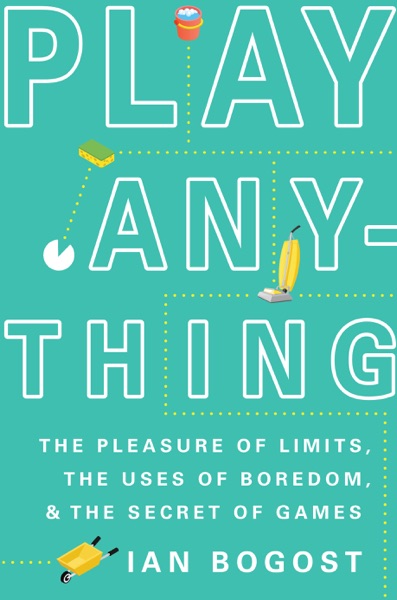
Play Anything by Ian Bogost is a 2016 philosophy book about play, attention, constraints. Play is not something we bring to enjoyable activities — it's a mode of attention we can direct at almost anything, including tedious or ordinary things.
Summary
Play Anything is Ian Bogost's argument that play is not something we bring to enjoyable activities — it's something we do with things, including tedious and unpleasant things, by paying them closer attention. Bogost is a game designer and media theorist at Georgia Tech, and his starting point is a challenge to the intuitive view that fun comes from freedom or personal satisfaction. Fun, he argues, is a byproduct of engaging closely with constraints, not escaping them.
The book's central term is "irony" in a philosophical rather than literary sense. Bogost means the gap between what we expect from the world and what we actually encounter — the ways things resist us and fail to match our demands. Most people experience this gap as frustration. Play, in Bogost's account, is the deliberate decision to explore that gap rather than close it: to be interested in the thing on its own terms rather than annoyed that it isn't what you wanted.
The argument runs through a series of case studies: a parking lot, a children's soccer game, the game of golf, shopping at Target, a lawn sprinkler. The point is not that these are secretly fun. It's that close attention to any system — its constraints, its logic, its internal coherence — can produce engagement that resembles what we normally call play. Bogost calls this "ludic" attention: attending to the world as a set of structures to explore rather than experiences to consume.
The prose is dense and occasionally difficult. Bogost is a philosophy-trained academic writing for a general audience, and the balance between intellectual precision and readability tips toward precision more often than most readers might prefer. The book rewards patience. Its central idea — that boredom is not a property of activities but of attention, that almost anything becomes interesting when you pay it the right kind of attention — is one of those ideas that changes what you do with idle time after you've absorbed it.
Talk to Play Anything like its author wrote you back.
Get the ideas that fit your life — not generic summaries.
- Chat with the book
- Audiobook-style main ideas
- Adapts to your life and goals
- Helps you take action
Key takeaways
- 1.
Play is not something we bring to enjoyable activities — it's a mode of attention we can direct at almost anything, including tedious or ordinary things.
- 2.
Fun is a byproduct of engaging with constraints, not escaping them. The game of golf is interesting because of the rules, not despite them.
- 3.
Bogost's 'irony' is the gap between what we expect from the world and what we encounter. Play is the decision to explore that gap rather than be frustrated by it.
- 4.
Boredom is not a property of activities but of attention. The same parking lot can be a source of genuine interest if approached with ludic rather than instrumental attention.
- 5.
Consumer culture promises fun as freedom — as the removal of constraints and the satisfaction of desire. Bogost argues this produces fragile pleasure and persistent dissatisfaction.
- 6.
Attending to things on their own terms — their internal logic, their constraints, their structure — is the core move of play, and it can be practiced deliberately.
- 7.
Children's play is instructive not because it's innocent but because children haven't yet learned to find the things around them boring. They attend to constraints rather than chafing against them.
- 8.
The concept of 'carpentry' in Bogost's broader work: making things that embody philosophical ideas. Play Anything applies this to how we inhabit the world rather than just how we make it.
Discussion questions
Use these on your own, with a book club, or as chat starters in Superbook. Book club version, ready to copy or print →
- 1.
Bogost argues that fun comes from constraint rather than freedom. Think of something you genuinely enjoy — does his account explain why, or does it miss something?
- 2.
His example of making a parking lot interesting is deliberately mundane. What mundane thing in your daily life could you attend to differently? What would change?
- 3.
The book challenges consumer culture's promise that fun comes from satisfaction and freedom. Where in your own life do you see that promise producing the dissatisfaction Bogost describes?
- 4.
Bogost distinguishes between instrumental attention (using things to get somewhere else) and ludic attention (attending to things for their own structure). When do you operate in each mode?
- 5.
If boredom is a property of attention rather than activity, what does that suggest about how you manage your own boredom?
- 6.
The book is written by a game designer. Does that background make his argument about non-game play more or less credible?
- 7.
Bogost's prose is dense and academic. Did the difficulty of reading the book change how you engaged with its argument?
- 8.
He argues children are not naturally playful — they just haven't learned to find things boring yet. Is that an encouraging or a depressing observation?
- 9.
What would it mean to approach your most tedious regular obligation — the most boring meeting, the most repetitive task — with the kind of attention Bogost describes?
- 10.
The book reads as a critique of self-help culture's focus on personal fulfillment. Do you find that critique convincing?
- 11.
Bogost uses golf as an example of constraint-based fun. Think of another activity that's interesting precisely because of its constraints. What makes those constraints generative rather than just frustrating?
Themes
Frequently asked questions
-
What is Play Anything about?
It argues that play is a mode of attention directed at constraints rather than something reserved for fun activities. Bogost claims that close, exploratory attention to the structure of almost any situation — a parking lot, a boring meeting, a children's game — can produce genuine engagement and what we normally call fun.
-
Is Play Anything easy to read?
No. Bogost is a philosopher-trained academic and the prose is dense, with a specialized vocabulary drawn from phenomenology and game theory. The core ideas are accessible once you're past the conceptual framework, but the book asks more of readers than most popular nonfiction.
-
Who should read Play Anything?
Readers interested in philosophy of mind, game design, or the phenomenology of everyday life. Also useful for people who've found productivity and mindfulness literature unsatisfying — Bogost's account of attention and engagement is more rigorous than most.
-
Is the book's argument convincing?
Partially. The case that constraints generate play rather than preventing it is well-made. The claim that you can make anything interesting through attention is both inspiring and a little pat — it doesn't fully account for situations where constraints are genuinely intolerable rather than generatively challenging.
-
How does Play Anything relate to game design?
Bogost uses game design as the original domain for thinking about constraint and play, then argues the same logic applies to ordinary life. You don't need a background in game design to follow the argument, but that background does make some of the examples more resonant.
Similar books
Four Thousand Weeks: Time Management for Mortals
Oliver Burkeman
Deep Work
Cal Newport
Flow: The Psychology of Optimal Experience
Mihaly Csikszentmihalyi
The Obstacle Is the Way
Ryan Holiday
