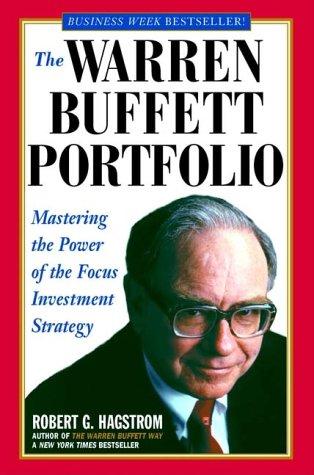
The Warren Buffett Portfolio by Robert G. Hagstrom is a 1999 economics book about value investing, portfolio concentration, long-term thinking. Concentration in businesses you understand deeply can produce better long-term results than diversification, which often hedges ignorance rather than managing genuine risk.
Summary
The Warren Buffett Portfolio is Robert Hagstrom's attempt to articulate not just what Buffett buys, but how he thinks about portfolio construction — specifically his case for concentration over diversification. Most investment theory, from modern portfolio theory to index fund orthodoxy, argues for spreading risk across many holdings. Buffett's approach is the opposite: owning a small number of businesses he understands deeply and holding them for very long periods. Hagstrom calls this "focus investing."
The book's central argument is that diversification is often a hedge against ignorance rather than a rational strategy. If you genuinely understand a business — its competitive advantages, its management quality, its economics — then spreading that conviction across fifty holdings dilutes rather than improves your expected outcome. Hagstrom traces the intellectual lineage of this view from Philip Fisher and John Maynard Keynes to Charlie Munger and Buffett himself, showing that focused, high-conviction portfolios have a long and respectable history.
The practical content covers how to evaluate a business as a long-term investment. Hagstrom distills Buffett's criteria into categories: business tenets (simple, consistent, good long-term prospects), management tenets (rational, candid, independent), financial tenets (strong return on equity, high profit margins, owner earnings), and market tenets (determining value, buying at a discount to that value). Each category is illustrated with case studies from Buffett's actual holdings, including Coca-Cola, Gillette, and The Washington Post.
The book also takes seriously the psychological difficulty of the approach. Concentrated portfolios are volatile in the short term, which requires an investor who can tolerate temporary paper losses without acting on them. Hagstrom addresses this honestly: focus investing produces better long-term results in most simulations, but almost no one can sit through the volatility without either selling or second-guessing the method. The psychological discipline required is, he argues, the real barrier to entry — not the analytical work.
Talk to The Warren Buffett Portfolio like its author wrote you back.
Get the ideas that fit your life — not generic summaries.
- Chat with the book
- Audiobook-style main ideas
- Adapts to your life and goals
- Helps you take action
Key takeaways
- 1.
Concentration in businesses you understand deeply can produce better long-term results than diversification, which often hedges ignorance rather than managing genuine risk.
- 2.
Buffett evaluates a business on four categories: business quality, management quality, financial performance, and price relative to intrinsic value.
- 3.
Owner earnings — net income plus depreciation minus capital expenditures required to maintain competitive position — is a better measure of true profitability than reported earnings.
- 4.
The psychological difficulty of holding a concentrated portfolio through short-term volatility is the main barrier to the strategy, not the analytical skill required.
- 5.
Long-term thinking changes the math of investing. Holding a great business for decades is fundamentally different from holding a stock position for years.
- 6.
Management candor and rationality are as important as financial metrics. Managers who allocate capital poorly or obscure bad news destroy value over time.
- 7.
Intrinsic value is what a business is worth based on its expected cash flows discounted to the present. Buying significantly below that value provides a margin of safety.
- 8.
Focus investing has historical precedent in Keynes's insurance fund management and Phil Fisher's growth stock philosophy, not just in Buffett's track record.
Discussion questions
Use these on your own, with a book club, or as chat starters in Superbook. Book club version, ready to copy or print →
- 1.
Hagstrom argues that diversification often reflects ignorance rather than wisdom. Do you find that persuasive, or does it feel like rationalization for concentrated risk?
- 2.
How many businesses do you think you could genuinely understand well enough to bet a large portion of your net worth on them?
- 3.
The book was published in 1999. How has the case for concentrated stock-picking aged against the rise of low-cost index investing?
- 4.
What does 'understanding a business' actually mean in practice? What would you need to know to feel confident about a ten-year holding commitment?
- 5.
Hagstrom describes the psychological challenge of holding through volatility. Have you experienced a situation where your analytical conviction conflicted with the feeling of watching a position fall? What did you do?
- 6.
Buffett's management criteria include candor and rationality in capital allocation. How would you assess those qualities in a CEO you haven't met?
- 7.
The book argues that a truly great business held for decades outperforms almost anything else. What makes a business great enough to hold forever?
- 8.
Owner earnings is a more conservative measure than reported GAAP earnings. Why do most investors and analysts focus on GAAP earnings instead?
- 9.
Focus investing requires accepting that your portfolio will look very different from the market in any given year. How much tracking error would you be able to live with?
- 10.
Keynes reportedly lost most of his investors' capital before finding his concentrated approach. How do you think about the relationship between conviction and accountability when managing others' money?
- 11.
Hagstrom includes Coca-Cola and Gillette as case studies. What would modern equivalents look like, and how would you identify them?
- 12.
If you had to pick five businesses to hold for twenty years starting today, what criteria would you use, and would you actually trust your own judgment enough to execute?
Themes
Frequently asked questions
-
What is focus investing?
Focus investing means owning a small number of high-conviction positions — Hagstrom suggests ten to fifteen businesses — held for the long term. The argument is that deep understanding of a few businesses produces better outcomes than shallow knowledge spread across many.
-
Is The Warren Buffett Portfolio still relevant?
The principles are durable, but the context has shifted. Low-cost index funds have raised the bar for active stock selection, and most research since 1999 suggests index funds outperform most active managers. The book is best read as a framework for thinking about business quality rather than as a prescription for beating the market.
-
How long does it take to read?
Around four to four-and-a-half hours at average reading pace. The book is dense in places, particularly the sections on intrinsic value and owner earnings, but the case studies move quickly.
-
Who should read this book?
Investors who are already comfortable with value investing basics and want to understand the portfolio construction logic behind concentration. Less useful for beginners or for investors who have already concluded that index funds are their preferred approach.
-
What's the difference between this book and The Warren Buffett Way?
The Warren Buffett Way focuses on how to evaluate and select individual businesses. The Warren Buffett Portfolio focuses on how to think about owning many such positions together — the concentration argument, volatility tolerance, and the psychology of holding through downturns.
Similar books
The Intelligent Investor
Benjamin Graham
The Snowball: Warren Buffett and the Business of Life
Alice Schroeder
The Essays of Warren Buffett
Warren Buffett
Common Stocks and Uncommon Profits
Philip A. Fisher
