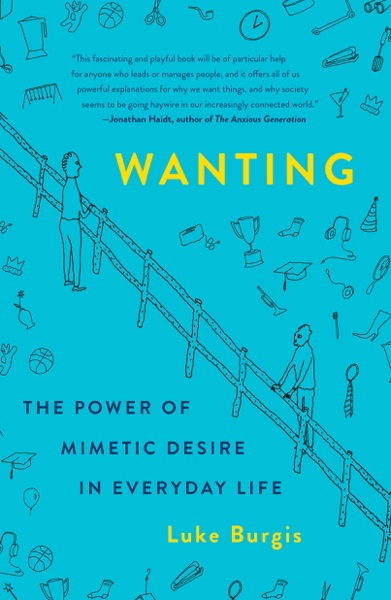
Wanting by Luke Burgis is a 2021 psychology book about desire, mimetic theory, social influence. Humans don't generate desires independently. They borrow them from 'models' — people they admire or compete with — through a process Girard called mimetic desire.
Summary
Wanting is Luke Burgis's attempt to bring René Girard's theory of mimetic desire to a general audience. Girard, a French literary critic and anthropologist who spent most of his career at Stanford, argued that human beings don't actually know what they want on their own. Instead, they borrow desires from other people — specifically from people they look up to or identify with. Those people function as what Girard called "models." We want things because our models want them, not because of any innate preference.
Burgis walks through the mechanics of this. Mimetic desire is invisible precisely because we experience it as internal and personal. The person who suddenly wants a particular career, a particular neighborhood, a particular status symbol — they feel like they're choosing freely. Girard's argument is that they're mostly responding to signals from their social environment. The more two people share the same model, the more likely they are to become rivals for the same thing, even when there's more than enough to go around.
The book's practical sections explore how mimetic desire shapes Silicon Valley, social media, financial markets, and romantic relationships. Burgis draws on his own experience building companies and advising entrepreneurs. The most dangerous situation, he argues, is proximity to a mimetic model without realizing that's what's happening. Startups that copy each other's features, investors who pile into the same trade, people who reorient their careers based on what their peer group values — all are running mimetic desire scripts without examining them.
Burgis proposes what he calls "thick desires" versus "thin desires." Thin desires are mimetic and fungible — wanting what others want because they want it. Thick desires are rooted in long-term goals and values that don't shift with social signals. The book's aim is to help readers identify which of their wants are genuinely their own and which are borrowed. That's harder than it sounds, and Burgis is honest that Girard's framework doesn't come with a neat escape hatch. Awareness helps, but it doesn't immunize.
Talk to Wanting like its author wrote you back.
Get the ideas that fit your life — not generic summaries.
- Chat with the book
- Audiobook-style main ideas
- Adapts to your life and goals
- Helps you take action
Key takeaways
- 1.
Humans don't generate desires independently. They borrow them from 'models' — people they admire or compete with — through a process Girard called mimetic desire.
- 2.
Mimetic desire is invisible because it feels like authentic wanting. Most people never realize how much of what they chase is borrowed from their social environment.
- 3.
The closer two people are to the same model, the more intense their rivalry becomes. Girard called this 'mimetic rivalry,' and it explains why competition is fiercest between near-equals.
- 4.
Social media is a mimetic desire accelerator. It shows everyone a curated feed of models, amplifying the borrowing of desire and shrinking the range of what people individually aspire to.
- 5.
Silicon Valley runs on mimetic desire — companies copying each other, founders seeking the same signals of validation, investors crowding into identical theses.
- 6.
Thick desires are tied to long-term goals and personal values that survive outside of social context. Thin desires evaporate when the model disappears or moves on.
- 7.
Awareness of mimetic patterns is the beginning of the antidote, but it's not sufficient on its own. You have to deliberately cultivate sources of desire outside your default social environment.
- 8.
René Girard's theory connects ancient scapegoat mechanisms to modern mob behavior, market bubbles, and social media pile-ons — all instances of mimetic contagion at scale.
Discussion questions
Use these on your own, with a book club, or as chat starters in Superbook. Book club version, ready to copy or print →
- 1.
Burgis argues that most of what we want is borrowed from models. Can you identify a recent desire of yours that might be mimetic rather than intrinsic?
- 2.
Who are the two or three most influential 'models' in your life right now? How much of what you're pursuing can be traced back to them?
- 3.
Have you experienced mimetic rivalry — competing intensely with someone who wanted the same thing not because of the thing's intrinsic value, but because of shared proximity to a model?
- 4.
Burgis distinguishes thick from thin desires. Which of your current goals feel thick, and which might actually be thin on closer examination?
- 5.
How has social media changed the range of what you want? Are the things you desire now more or less similar to what your peer group desires?
- 6.
Girard argues that all human conflict originates in mimetic desire. Does that feel like an overstatement, or does it explain patterns you've seen in your own relationships?
- 7.
What would it mean to escape your current mimetic environment? What models would you need to add or remove from your life?
- 8.
Burgis writes about 'anti-models' — people we define ourselves against. Who are yours, and are you sure you're not actually still mimetically entangled with them?
- 9.
Financial markets are one of Burgis's key examples. Can you think of an investment, purchase, or career move you made primarily because of mimetic pressure rather than genuine analysis?
- 10.
What would your career look like if you had grown up in a completely different social environment, with different models? How different do you think it would be?
- 11.
Girard spent decades trying to understand sacred violence and the scapegoat mechanism. Does his theory of mimetic rivalry help explain any recent public events you've watched?
- 12.
Burgis ends with the idea of pursuing 'being' over 'having.' What does that distinction mean to you in your actual life, not as a philosophical abstraction?
Themes
Frequently asked questions
-
What is the main idea of Wanting by Luke Burgis?
The book argues that human desire is mostly mimetic — we want things because other people we identify with want them, not because we independently decided to. Burgis draws on René Girard's theory and applies it to business, social media, relationships, and everyday decision-making.
-
Do I need to know René Girard before reading Wanting?
No. Burgis introduces Girard's ideas from scratch. He explains mimetic theory in accessible terms and builds it out with contemporary examples. Readers familiar with Girard will find the applications interesting; others will have no trouble following from the beginning.
-
Is Wanting worth reading?
For anyone interested in understanding why they want what they want, yes. The framework is genuinely clarifying once it lands. The book is uneven in places — the practical sections are stronger than the philosophical ones — but the central idea is useful enough to make the whole worth reading.
-
How long is Wanting?
About five hours at an average reading pace. The book is around 280 pages, with a mix of theory, business case studies, and personal narrative. It's more intellectually demanding than most popular psychology books but not difficult to read.
-
Who should read Wanting?
Entrepreneurs, investors, and anyone who has noticed that they often end up chasing the same goals as their peer group without being sure why. Also useful for anyone trying to make a significant life decision and wanting a framework for separating genuine preference from borrowed desire.
Similar books
Thinking, Fast and Slow
Daniel Kahneman
Influence: The Psychology of Persuasion
Robert B. Cialdini
Predictably Irrational
Dan Ariely
The Righteous Mind: Why Good People Are Divided by Politics and Religion
Jonathan Haidt
