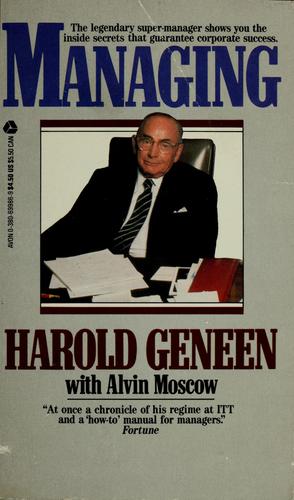
Managing by Harold Geneen is a 1984 business book about management, leadership, business performance. The most important task of a manager is getting the facts — not the comfortable version, not the polished version, but the actual situation as it exists. Most organizations systematically obscure this.
Summary
Managing is Harold Geneen's account of the principles that governed his twenty-year tenure as CEO of ITT, which he transformed from a modest international telephone company into one of the largest conglomerates in the world. Geneen ran ITT from 1959 to 1977, growing revenues from $765 million to $17 billion through a combination of aggressive acquisition, strict financial controls, and a management culture built on what he called "unshakeable facts."
Geneen's central distinction is between facts as managers wish they were, facts as they appear to be, and facts as they actually are. Most organizational failure, in his view, comes from people working with the first or second category while believing they have the third. His solution was the monthly management meeting in Brussels where all ITT division heads and their staffs would assemble for extended sessions — sometimes days — in which every business was reviewed against its numbers with Geneen himself asking questions until he was satisfied the reported facts matched reality. The meetings were legendary for their intensity and for Geneen's refusal to accept hedged answers.
The book is direct about what Geneen believes management actually requires: total immersion, continuous attention, and a willingness to confront bad news faster than it would naturally surface. He is contemptuous of management theories and frameworks, arguing that managing is an empirical discipline that must be learned from doing and that no amount of reading cases at business school substitutes for the actual experience of running a business. He quotes himself more than he cites anyone else.
Geneen's methods are not universally applicable, and he acknowledges this. The conglomerate structure he built has largely been abandoned by the corporate world as evidence accumulated that diversified conglomerates trade at a discount. His approach to management was also intensely personal and dependent on his own capacity to absorb enormous quantities of operating data — not a model that scales beyond a particular kind of exceptional individual. But as a document of how one extremely capable manager thought about the craft of running an organization, it remains unusually candid and specific.
Talk to Managing like its author wrote you back.
Get the ideas that fit your life — not generic summaries.
- Chat with the book
- Audiobook-style main ideas
- Adapts to your life and goals
- Helps you take action
Key takeaways
- 1.
The most important task of a manager is getting the facts — not the comfortable version, not the polished version, but the actual situation as it exists. Most organizations systematically obscure this.
- 2.
Bad news should travel faster than good news. A culture where managers delay reporting problems until they have solutions is a culture where problems compound before leadership knows they exist.
- 3.
Numbers are a language for facts but not facts themselves. Geneen insisted on understanding the business behind the numbers rather than managing the numbers directly.
- 4.
Management cannot be learned from theory alone. The only way to develop managerial judgment is to manage — to make decisions, observe their outcomes, and absorb the feedback.
- 5.
Accountability requires specificity. Geneen's operating reviews worked because every manager knew they would be questioned on every significant number, not allowed to hide behind aggregates.
- 6.
Acquisitions are easier than integration. ITT's growth came partly from Geneen's discipline in actually operating the businesses it acquired rather than letting them drift as portfolio investments.
- 7.
The CEO's primary job is to ensure that the organization produces results, not to manage relationships, build culture, or communicate strategy. Results are the measure of everything else.
Discussion questions
Use these on your own, with a book club, or as chat starters in Superbook. Book club version, ready to copy or print →
- 1.
Geneen's distinction between facts as they seem and facts as they are is easy to accept in principle and hard to apply in practice. Where in your own work do you most often mistake category two for category three?
- 2.
His Brussels meetings ran for days and were famously intense. What does that investment of time signal about what Geneen actually believed mattered in management?
- 3.
Geneen says bad news should travel faster than good. What organizational structures or incentives in places you know work against that principle?
- 4.
He is dismissive of management theory and business school case methods. Is that dismissiveness a strength — focus on empirical reality — or a weakness that prevented him from learning from others' experience?
- 5.
The conglomerate model ITT represented has mostly been abandoned. Does that outcome retroactively undermine Geneen's management principles, or were the principles sound and the strategy separate?
- 6.
Geneen describes himself as absolutely committed to results above everything else. What does an organization lose when results become the only measure of performance?
- 7.
His approach to operating reviews — personal interrogation of every manager on every significant number — is not replicable by most leaders. What can be extracted from it that scales?
- 8.
Geneen believes the best managers learned primarily from doing. How much of your own management development has come from formal training versus the experience of actually running things?
- 9.
He talks extensively about accountability. How do you distinguish genuine accountability — consequences attached to outcomes — from performative accountability, where the process happens but consequences don't follow?
- 10.
Geneen ran ITT as a highly centralized operation despite its size and diversity. What are the limits of centralization, and how would you know when you've exceeded them?
- 11.
The book is an autobiography-as-management-text. How does that format affect its reliability? What would you want to hear from the people who reported to Geneen?
Themes
Frequently asked questions
-
Is Managing worth reading today?
Yes, for the specificity of its operational thinking. Geneen describes the craft of management — how to get real information, how to run reviews, how to hold people accountable — in unusually concrete terms. It is more useful than most contemporary management books that stay at the level of principles.
-
What made Geneen's management style distinctive?
His insistence on direct engagement with operating reality rather than summaries, and his refusal to accept uncertainty about what was actually happening in any part of the business. The Brussels meetings, where every division was reviewed in detail with Geneen personally asking questions, were the structural expression of that philosophy.
-
Is the conglomerate model Geneen built still relevant?
The diversified conglomerate as a corporate structure has largely been abandoned — most evidence suggests focused companies outperform diversified ones over time. But Geneen's management principles are separable from the conglomerate strategy and remain applicable in any large, complex organization.
-
Who should read this book?
Operating managers who want to think more carefully about how to get accurate information from their organizations, and anyone interested in the history of American business in the postwar era. It is less useful for startup contexts and more relevant to mature, multi-unit organizations.
-
How long does it take to read?
About five hours at average pace. The prose is direct and the book doesn't waste space on frameworks or diagrams. Some repetition in the middle slows the pace slightly.