
Topic · 10 books
The best books on long-term thinking
Long-term thinking is the practice of extending your decision-making horizon beyond the current quarter, the current administration, or your own lifetime — and adjusting your actions accordingly. It draws on deep history, evolutionary biology, systems dynamics, philosophy, and the nascent discipline of longtermism. In a culture that rewards speed and immediate feedback, it is among the least practiced and most consequential cognitive skills.
-
01
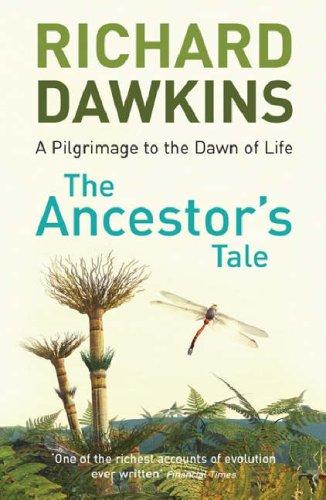
Richard Dawkins
Dawkins narrates the whole of evolutionary history as a pilgrimage backward in time, meeting ancestors at each branching point. The cumulative effect is a felt sense of deep time that no abstract statement about 'billions of years' can produce. Reading this first recalibrates everything that follows.
-
02
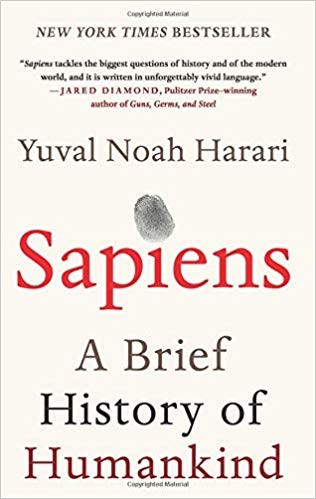
Sapiens: A Brief History of Humankind
Yuval Noah Harari
Harari's survey of Homo sapiens from cognitive revolution to the present makes the long-term case by compression: 70,000 years of human history in one arc. Particularly useful here for the chapters on imagined orders — how the fictions that coordinate large groups (money, laws, nations) are both load-bearing and revisable.
-
03
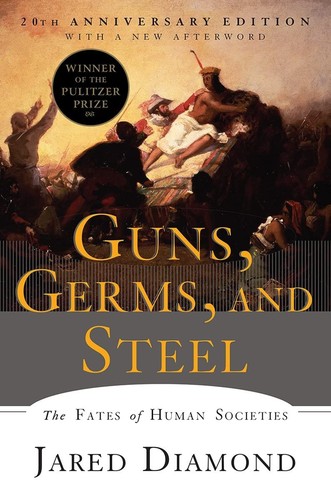
Jared Diamond
Diamond's central question — why did some civilizations come to dominate others over 10,000 years? — is precisely the kind of question that requires long-term thinking to even ask. The answer, rooted in geography and biology rather than culture or intelligence, is a model for how to reason about slow causes and fast effects.
-
Read these with Superbook
Chat with any book on this list — ask questions, get answers tuned to you.
-
04
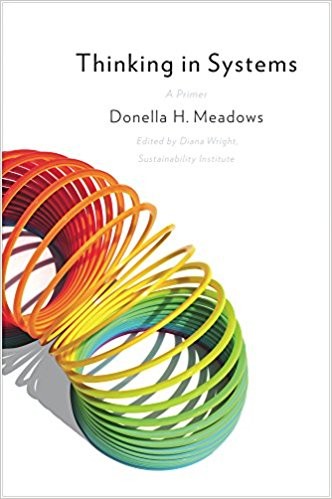
Donella H. Meadows
Meadows wrote this before systems thinking became a popular phrase, and it remains the clearest account of why short-term interventions in complex systems so often backfire. The chapter on leverage points is the conceptual core of what long-term thinking actually requires from decision-makers.
-
05
Stewart Brand
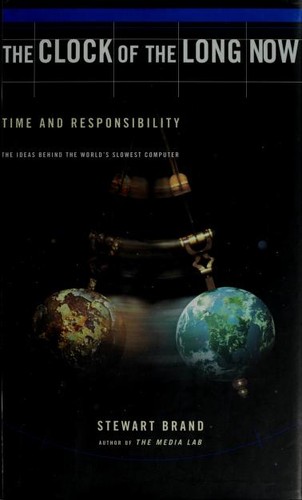
Brand's book is the founding document of institutional long-term thinking. It proposes a 10,000-year clock as a forcing function for civilizational patience, and along the way develops the concept of pace layers — the idea that different structures (fashion, commerce, governance, culture, nature) change at radically different speeds, and that confusing these speeds is the root of most short-termism.
-
06
The Uninhabitable Earth: Life After Warming
David Wallace-Wells
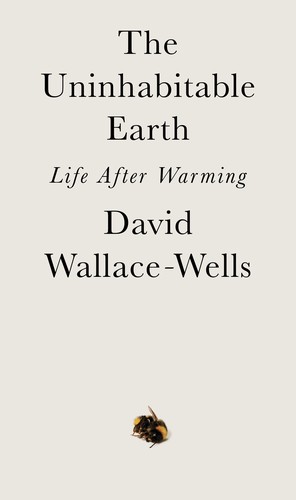
Wallace-Wells's inventory of worst-case climate projections is included here not as a climate book but as a case study in what happens when institutions consistently discount long-term risk. The scenarios he describes are already visible in the data; they were predictable decades ago. This is what the failure of long-term thinking looks like from inside it.
-
07
Roman Krznaric
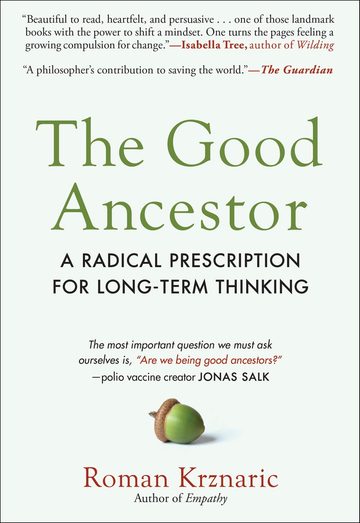
Krznaric surveys six ways of thinking that orient people toward longer horizons — from the cathedral builders of the medieval period to Iroquois seven-generation decision-making. His concept of 'acorn brain' versus 'marshmallow brain' is a useful diagnostic for why institutions favor short-term reward even when long-term thinking is available.
-
08
William MacAskill
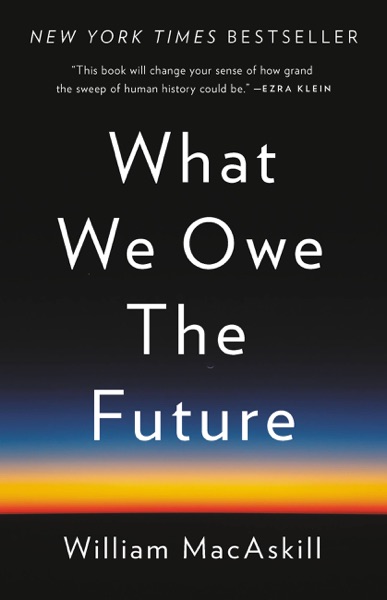
MacAskill's longtermist argument, grounded in effective altruism, is the most rigorous philosophical case for prioritizing future people. His core claim — that if the future contains vast numbers of people, influencing its trajectory matters more than almost anything we might do for the present — is informed by Derek Parfit's work on personal identity and is the most demanding version of the long-term thinking argument.
-
09
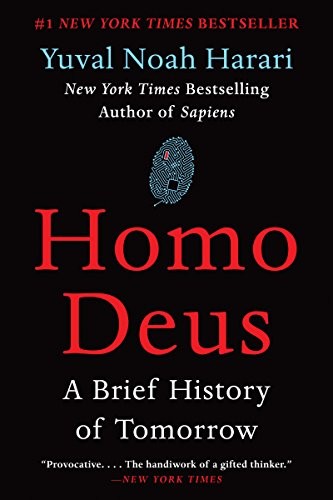
Homo Deus: A Brief History of Tomorrow
Yuval Noah Harari
Where Sapiens traces the arc of the past, Homo Deus projects it forward: what does humanity want next, now that it has largely conquered famine, plague, and war? Harari's scenarios — dataism, bioengineered happiness, the merging of human and algorithm — are less predictions than a structured way of thinking about which long-term trajectories are actually available.
-
10
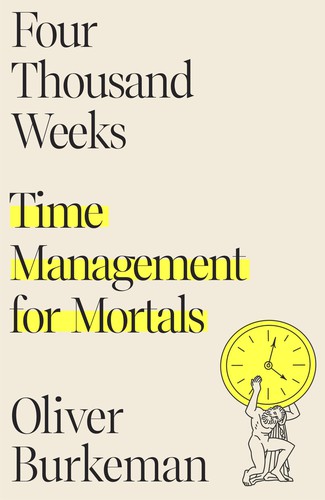
Four Thousand Weeks: Time Management for Mortals
Oliver Burkeman
Burkeman's book on finitude is the necessary counterweight to grandiose civilizational thinking. Four thousand weeks is approximately an 80-year life, and Burkeman's argument — that productivity systems typically function as denial mechanisms against this fact — forces the question of how a mortal agent ought to orient toward long-term causes. The tension between personal finitude and multigenerational obligation is never fully resolved here, which is exactly right.
More about this list
This list builds an argument across ten books. It starts with the longest possible lens — the full sweep of human and pre-human history — and gradually narrows toward the practical question of how individuals and institutions might actually act differently once they have internalized what deep time reveals.
The first three books establish a baseline. Dawkins's evolutionary genealogy and Harari's civilizational survey each, in different ways, make the same point: most of what feels permanent is recent, and most of what feels urgent is local. Diamond then shows what happens when societies fail to read the long-term signals embedded in their own geography and resource base.
From there, the list moves into the mechanics of long-horizon thinking. Donella Meadows's systems primer explains why complex systems are so resistant to short-term interventions — and what leverage really means. Brand's meditation on the Long Now clock project translates that insight into a cultural argument: that civilization has a pace problem, not just a policy problem.
The second half of the list is about moral and political obligations across time. Krznaric assembles the philosophical and practical case for what he calls 'cathedral thinking' — designing for generations you will never meet. MacAskill's longtermist argument is more rigorous and more demanding: if future people matter morally, their sheer number dwarfs the present. Parfit's analysis of personal identity, which underpins that argument, is represented here through his accessible essays rather than the full weight of Reasons and Persons.
The final two books are correctives. Wallace-Wells shows what long-term neglect actually looks like when it arrives as a physical emergency. And Burkeman's book on mortality and finite time is the necessary counterweight to any grandiose civilizational framing: the person doing the thinking lives for four thousand weeks, not ten thousand years, and that constraint shapes everything.
